Abstract
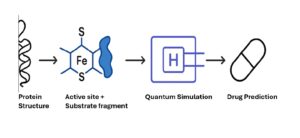 Quantum chemistry plays a crucial role in advancing fundamental understanding of chemical processes and driving innovation in energy, medicine, and materials science. Recent progress in quantum computing has opened new possibilities for molecular simulations that are beyond the practical limits of classical approaches. Academic studies have demonstrated hybrid Density Functional Theory (DFT) and Variational Quantum Eigensolver (VQE) benchmarks on small transition-metal systems, such as iron porphyrin and heme analogues, using current noisy intermediate-scale quantum (NISQ) hardware. Although full-scale simulations of complex biological systems such as the complete Cytochrome P450 (CYP450) active site remain a long-term goal due to limitations in qubit numbers, coherence times, and error correction, the underlying methodologies are now well established. At present, quantum chemistry applications in drug discovery remain largely experimental, and widespread practical medical impact is expected to require further technological advances over the next 5–10 years. Nevertheless, quantum software and algorithm development for chemical applications is progressing rapidly. This perspective summarizes recent advances in quantum computing algorithms, hardware, and software relevant to chemistry, and critically discusses the remaining challenges and opportunities for applying quantum computing to chemical problems, with particular emphasis on drug discovery and development.
quantum chemistry, quantum physics, quantum computing, scientific exploration, technological innovation, drug discovery & development