Abstract
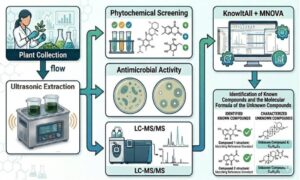 Capparis spinosa L. plant metabolites were extracted using ultrasonic wave and prepared for metabolism analysis by liquid chromatography-mass spectrometry (LC-MS/MS). The analysis revealed many phytochemicals such as flavonoids, phenolics, glycosides, tannins, saponins and terpenoids; however, no alkaloids were demonstrated in the extract. The antimicrobial activity of the C. spinosa extract was evaluated using the disc diffusion method against four bacterial species: Escherichia coli (ATCC 8739), Pseudomonas aeruginosa (ATCC 27853), Staphylococcus aureus (ATCC 6538), and Enterococcus faecalis (ATCC 29212). Growth inhibition was observed only for E. coli. The LC-MS/MS metabolomics approach permitted the identification of 6 high-confidence metabolites and 33 possible (tentative) metabolites based on spectral matching from the C. spinosa extract. The most abundant classes of metabolites detected were organic acids, amino acids, and phenolic compounds, which agreed with the phytochemical screening. The low antimicrobial activity of the extract was most probably associated with the extraction conditions and metabolite specificity.