Abstract
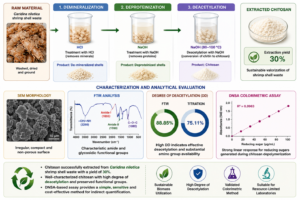 Chitosan is a biodegradable biopolymer with diverse agricultural, biomedical, and industrial applications; however, information on chitosan derived from Caridina nilotica shrimp shell waste remains limited in East Africa. In this study, chitosan was extracted from Kenyan shrimp shell waste, yielding 30%, and characterized using Fourier-transform infrared spectroscopy (FTIR), scanning electron microscopy (SEM), acid–base titration, and a 3,5-dinitrosalicylic acid (DNSA)-based colorimetric assay. FTIR confirmed the characteristic functional groups of chitosan, while the degree of deacetylation was 88.85% by FTIR and 75.11% by titration, reflecting the complementary structural and chemical principles underlying the two methods. The DNSA assay exhibited excellent linearity (R² = 0.9963) and provided a rapid, inexpensive, and accessible approach for indirectly assessing chitosan depolymerization. These findings demonstrate that C. nilotica shrimp shell waste is a promising source of functional chitosan and that the DNSA assay is a useful complementary tool for chitosan characterization in resource-limited laboratories.
Keywords
Degree of deacetylation, 3,5-dinitrosalicylic acid, Biomass Valorization, Sustainable biomaterials, C. nilotica