Abstract
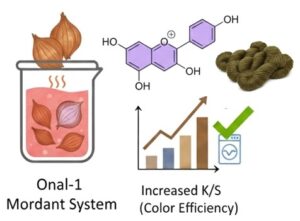 Some vegetable dyestuffs exhibit low affinity for natural fibers such as wool, cotton, and leather, which reduces their coloring efficiency. To enhance color uptake, transition metal salts such as copper sulfate (CuSO₄·5H₂O), iron sulfate (FeSO₄·7H₂O), alum (AlK(SO₄)₂·12H₂O), and tin chloride (SnCl₂) are commonly used as mordants, which act as stabilizers. However, dyeings produced with these salts often show limited light and washing fastness. In this study, we report the dyeing of wool yarns using Onal-1 mordant, based on bovine urine, and Allium cepa peel extract, which increases color efficiency (K/S). The main components of bovine urine – urea (H₂NCONH₂), ammonia (NH₃), and calcium oxalate (CaC₂O₄) – were analyzed. The mordanting effects of individual components, binary mixtures, and ternary mixtures were evaluated experimentally, revealing that the most effective formulation was a ternary mixture of 3% urea (v/v H₂O), 3% ammonia (v/v H₂O), and 3% calcium oxalate (g/v H₂O). This Onal-1 mordant system was applied to wool yarns, and the K/S values of pretreated fibers were found to be higher than those of untreated fibers. Among all mordants tested, the highest K/S value (K/S = 29.27) was achieved using the post–mordanting method with CuSO₄.