Abstract
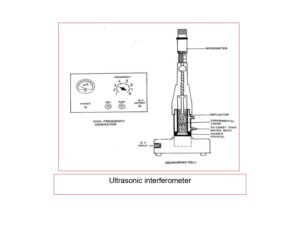
The present study examines the Thermophysical and ultrasonic behavior of the benzene + benzyl alcohol binary mixture over the temperature range of 298.15–313.15 K. Experimental measurements of density (ρ) and ultrasonic velocity (U) were used to evaluate derived parameters such as isentropic compressibility (βₛ), thermal expansion coefficient (α), isothermal compressibility (βT), internal pressure (Pi), and heat capacity ratio (γ) at different mole fractions. Theoretical estimations were performed using the Prigogine–Flory–Patterson (PFP) model, and excess properties were correlated using the Redlich–Kister polynomial equation. Percentage deviations between experimental and theoretical ultrasonic velocity and compressibility were analyzed to assess the predictive capability of the PFP model. The observed variations in thermo-acoustical parameters with temperature and composition suggest the presence of specific molecular interactions arising from polarity differences and associative tendencies of benzyl alcohol; however, these interaction mechanisms are inferred from Thermophysical behavior rather than independently confirmed. Taken together, the combined experimental–theoretical analysis provides useful insight into the non-ideal mixing behavior and structural organization of the benzene + benzyl alcohol system.