Abstract
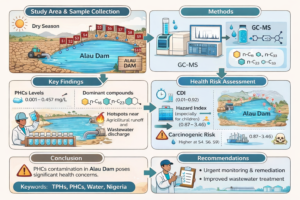 Petroleum hydrocarbons (PHCs) are persistent pollutants with serious ecological and health implications, especially in oil-impacted aquatic systems. This study evaluated the concentration, distribution, and health risks of PHCs in dry-season water samples from Alau Dam, Konduga LGA, Borno State, Nigeria. Water from ten sampling points S1–S10 was analyzed using GC–MS. PHCs concentrations ranged from 0.001 to 0.457 mg/L, with elevated levels near agricultural runoff and wastewater discharge areas. Dominant compounds included n-alkanes such as n-C16, n-C23, and n-C33. CDI values ranged from 1.12 × 10⁻⁵ to 8.43 × 10⁻³ mg/kg/day. Hazard Quotients (0.01–0.92 suggested low individual risk; however, cumulative Hazard Index values exceeded safety limits at several sampling points, particularly for children 0.87–3.46. Carcinogenic risks were above USEPA limits, with higher risks at S4, S6, and S9. Overall, PHCs contamination poses significant health concerns, warranting urgent monitoring and remediation.