Abstract
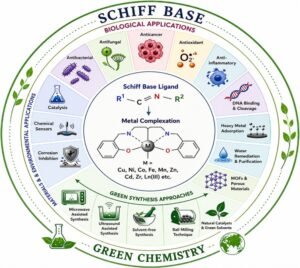 Schiff base ligands are essential for a number of chemical reactions because of their adaptable coordination skills and adjustable characteristics. This paper examines the latest developments in the synthesis of Schiff base ligands, comparing conventional condensation methods with green synthetic approaches such as natural acid catalysis, aqueous media synthesis, mechanochemistry, microwave-assisted synthesis, and ultrasound irradiation. Their coordination chemistry is examined in terms of donor modes, coordination geometries, and spectroscopic/crystallographic characterization, with attention to how ligand structure and metal-ion selection govern structure–activity relationships, supported by recent computational and spectroscopic advances in understanding metal–ligand interactions. Biological activities, including antibacterial, antifungal, anticancer, antioxidant, and anti-inflammatory effects, and their mechanisms are discussed alongside applications in catalysis, chemical sensing, corrosion inhibition, metal–organic frameworks, and environmental remediation. Current limitations in scalability, reproducibility, and clinical translation are outlined, together with future directions emphasizing sustainable synthesis, advanced characterization, and rational ligand design.
Keywords
Schiff bases, Green synthesis, Coordination chemistry, Biological activities Catalysis, Sustainable chemistry, Environmental applications.